Birds Aren't Real (Yet)
The missing dimension
I have spent the last four days in Fusion 360 trying to turn a clay bird into a printable enclosure. I now know two things with certainty. One: Fusion 360 is an incredibly powerful tool. Two: I am not an incredibly powerful user of it.
The problem is spatial reasoning. I don’t have it. I can hold a data pipeline in my head. I can trace a function call through six layers of abstraction. I can reason about soil water potential using equations I learned last month. But ask me to picture what a shape looks like when you rotate it 180 degrees and I will confidently get it wrong every single time.
This is a problem when you’re designing a 3D enclosure.
The print loop
The Bambu Labs printer is fast enough that iteration is measured in hours, not days. Which is good, because I have been iterating a lot. The loop goes like this: model something in Fusion 360, convince myself it’s right, slice it, print it, pull it off the build plate, hold it up, and discover that the thing I was sure was facing inward is facing outward. Or the hole I made for the sensor is on the wrong side. Or the snap fit I designed doesn’t snap because I mirrored it backwards.
Then I go back to Fusion 360 and do it again. And again.
The timelapses are satisfying, at least. There’s something meditative about watching a bird materialize layer by layer over two hours, even if you know the beak is going to be on backwards.
What I’m actually building
The bird shell is the top piece. It holds the microcontroller and sensor breakout boards, the light/UV sensor behind the eye, and the VOC sensor vented through the shell. It connects to the Perch below, which is the battery and port housing. The Perch is a simpler shape, basically a cylinder. The bird is the hard part.
Getting the internal cavity right is the real challenge. The microcontroller needs to sit so the antenna points up for range. The sensor windows need to align with the shell openings. The whole thing needs to be thick enough to print reliably but thin enough to not weigh down the soil prong. And it needs to look like a bird.
That last requirement is doing most of the damage to my sanity.
The failures
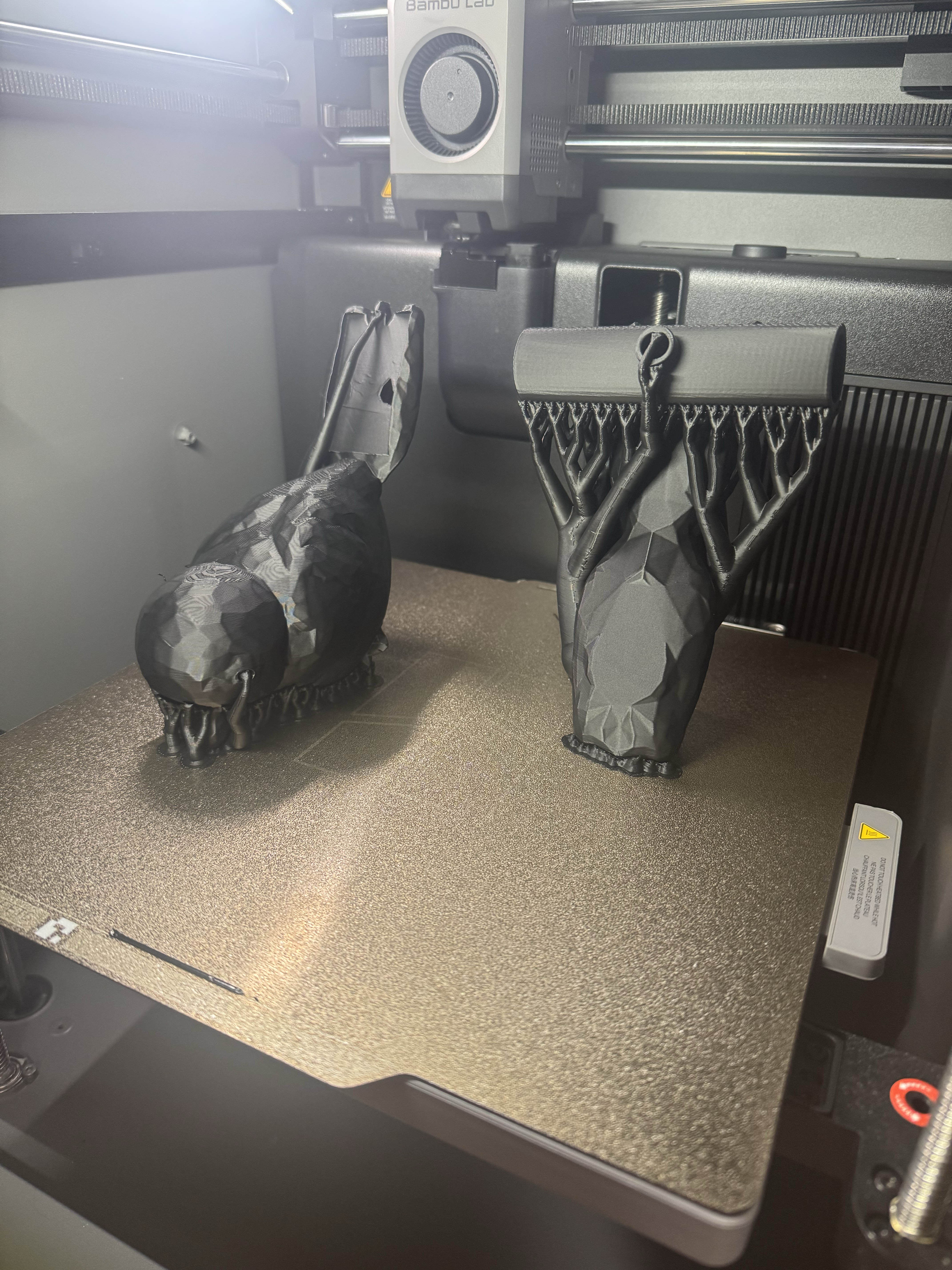
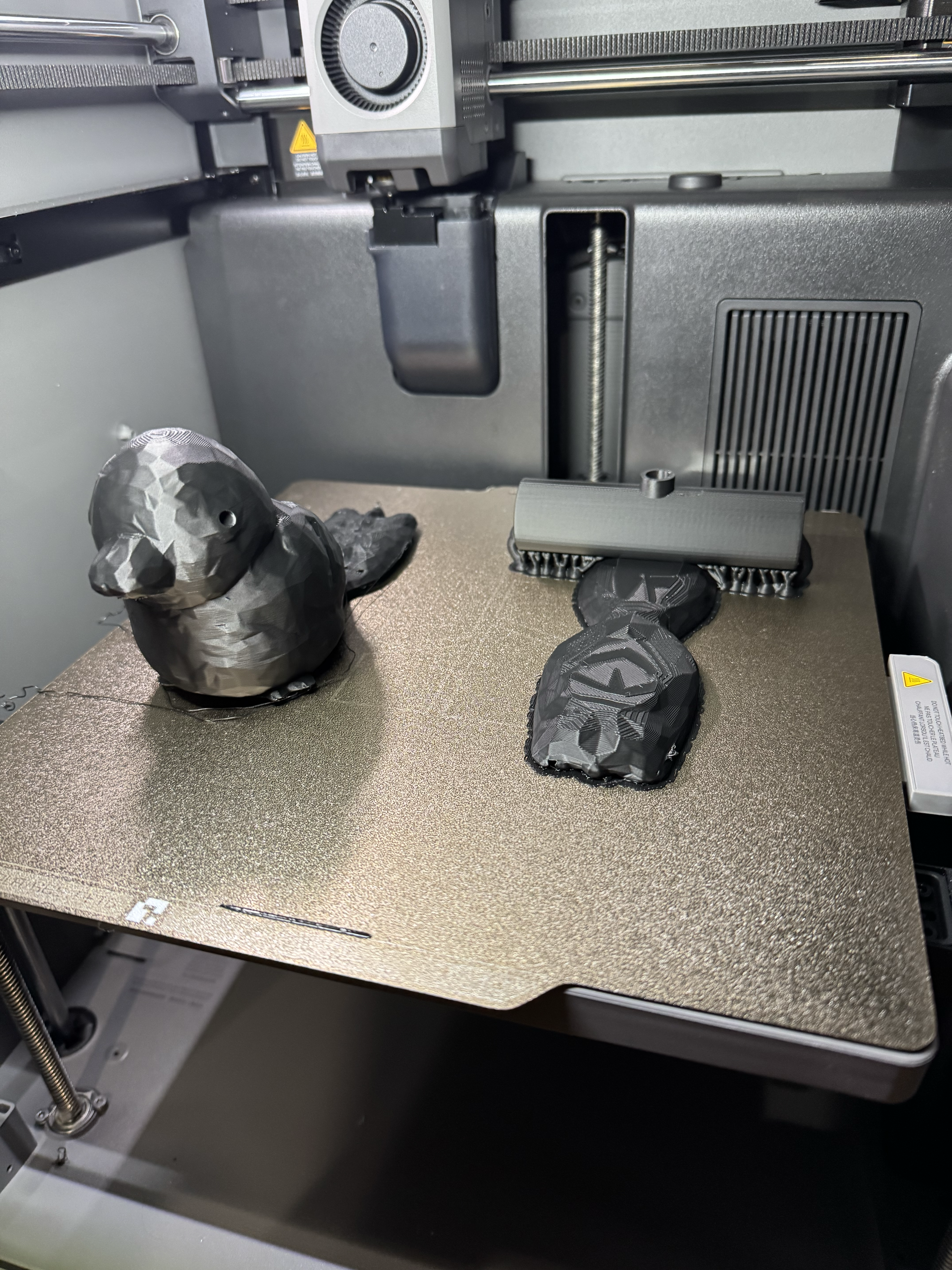
I’m not going to pretend the first few prints were close. They were not close. Press fits that didn’t press or fit. Holes that looked right in the model but were too small to actually pass a wire through. Cutouts that weren’t fully cut out, leaving a thin membrane of PLA where a sensor window should be. And the big one: the original model was just too small. The clay sculpture is tiny. The breakout boards I’m trying to jam inside it are not. Scaling up the whole bird while keeping the proportions right took more iterations than I’d like to admit.
I am learning Fusion 360 the way I learn everything: by doing it wrong enough times that the right way becomes obvious.
The fear
Here’s the thing I haven’t said out loud yet. The enclosure is just a shell. The real terrifying part is what goes inside it. I just downloaded KiCad. As in, today. As in, it is sitting on my dock right now, unopened, radiating energy.
I have never designed a PCB. I have wired breakout boards together with jumper cables and crossed my fingers. I have soldered headers onto things other people designed. But laying out traces on a board, choosing components from catalogs, worrying about clearances and impedance and ground planes? That’s a different universe. And it’s the next thing on the list.
If Fusion 360 exposed my lack of spatial reasoning, KiCad is about to expose my lack of electrical engineering. I’m a data scientist who got into electronics because a garden made him curious. At some point the self-taught enthusiasm runs into a wall of actual domain expertise and you have to either learn it or find someone who knows it.
I’m going to try learning it.
The progress
Despite the spatial reasoning deficit, I’m getting somewhere. The current print is recognizably a bird. It fits the breakout boards. The sensor windows are in the right place. The Perch connector interface lines up.
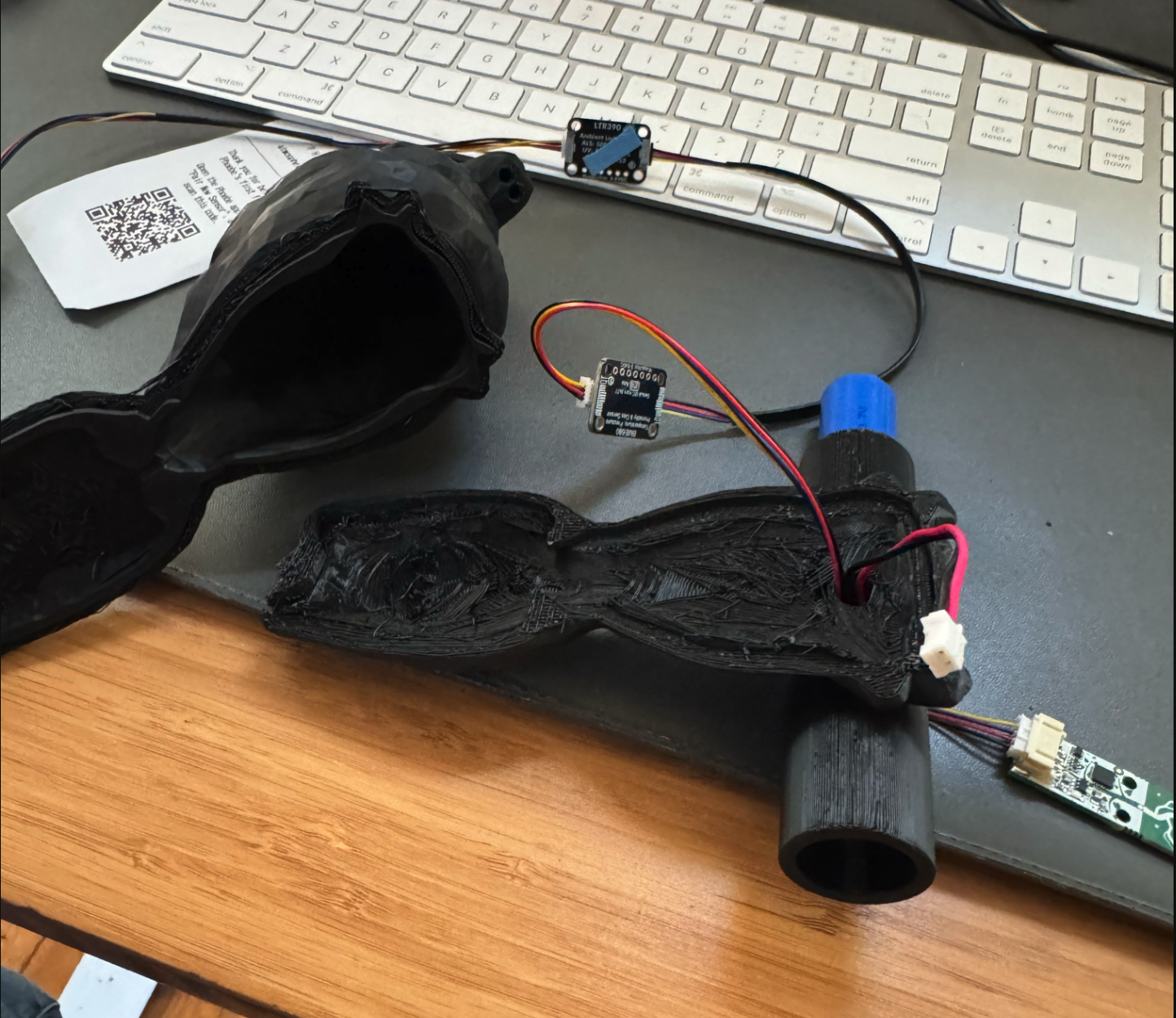
I was worried the tail had too much junk in the trunk. My wife looked at it and said “that’s where you put a solar panel.” She’s right. The flat area on the tail is the perfect size for a small panel to trickle charge the battery. We’re prototyping a few prints with that cutout in place.
It’s not beautiful, but it’s functional, and for a first custom enclosure designed by someone who never took shop class, I’ll take it.
Somewhere in Ohio, the clay model my sister made is sitting on a shelf. On my desk, a black PLA test print is trying to live up to it. The real ones will be translucent PETG, because it’s a cool retro 90s vibe, it lets UV light through to the sensor, and it’s what I had. OK? They’re slowly converging.
— Ben