Rat's Nest
Traces everywhere
In KiCad, before you route your PCB, you see the “rat’s nest.” It’s a tangle of thin lines showing every electrical connection that needs to exist but doesn’t yet have a physical trace. Your job is to turn that mess into actual copper paths that don’t cross each other, don’t violate clearance rules, and fit on a board the size of a thumb drive.
I did this on Metro North.
The itinerary
Yesterday was a day in the city. Meetings, a startup event, a visit to the New Museum. Somewhere in between all of that, I designed Phoebe’s spine PCB. The likelihood that this board actually works is directly proportional to the chaos of its creation:
Metro North Hudson Line, southbound. Opened KiCad on a moving train. Placed the ESP32-C6 module, the boost converter, the battery management IC. The train rocked. The components shifted. I hit undo a lot.
Breakfast meeting, Midtown. A table of AI developers. We all agreed we have no idea what’s happening. Comforting.
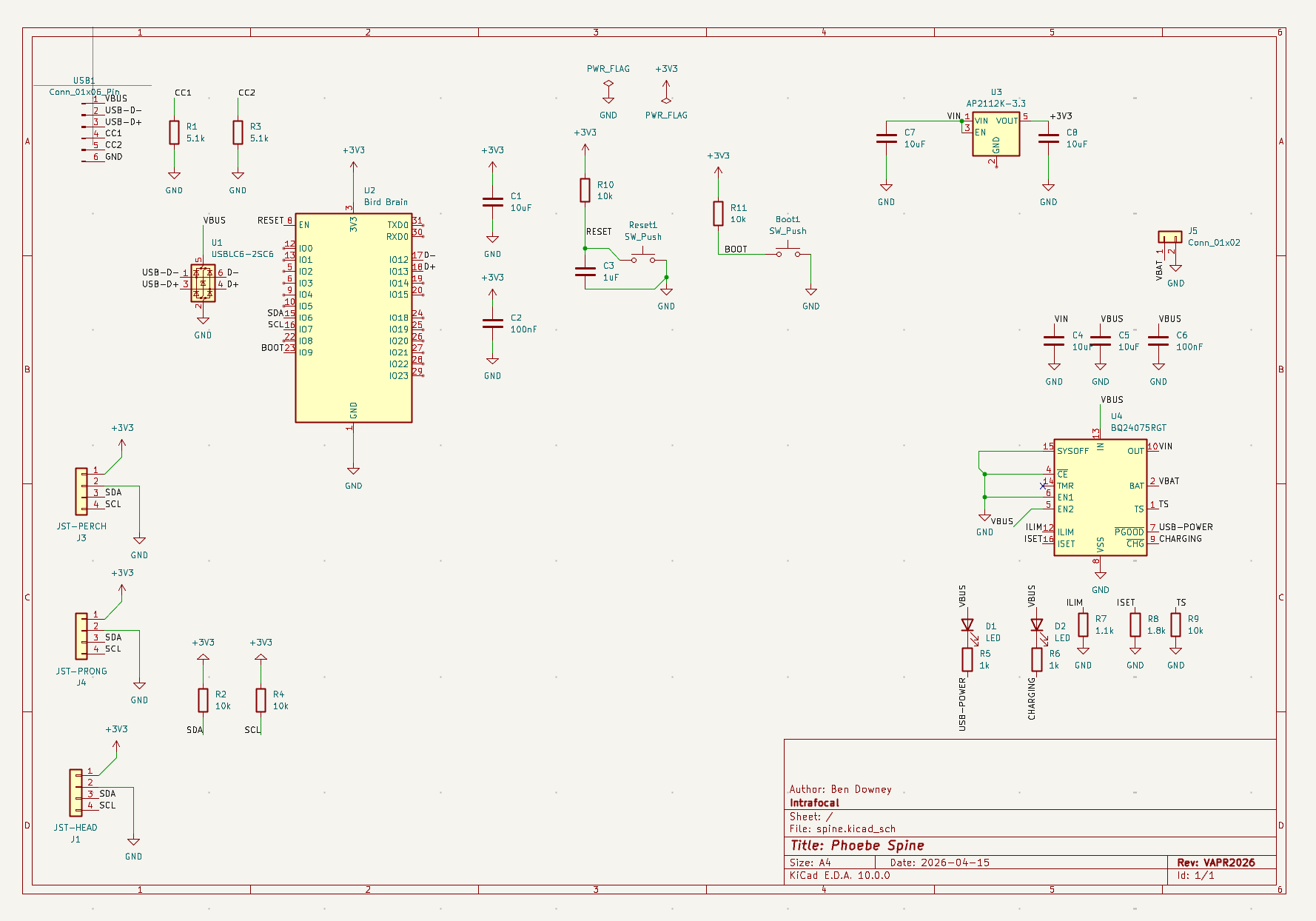
Variety Coffee Roasters, 7th Ave. Sat down next to two theater producers spilling the tea on their latest shows. Got the schematic roughed out while eavesdropping. The I2C bus, the USB-C charging circuit, the antenna keepout zone.
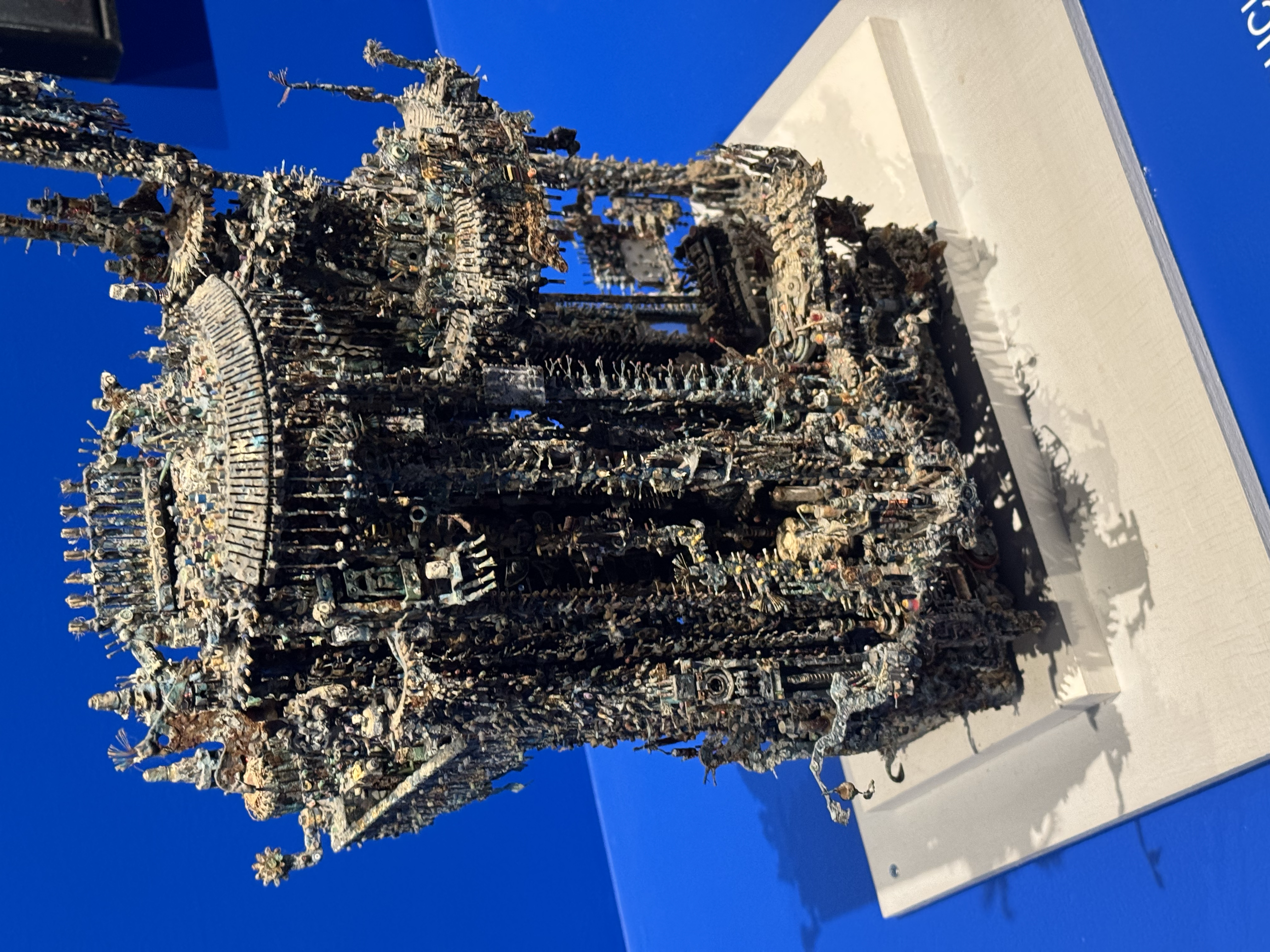
New Museum, Bowery. Lots of fascinating and terrifying art about how machines change our relationships to our own physicality. Relevant to building a little robot bird, probably. Closed KiCad for this one.
L train to Williamsburg. Seeing traces everywhere now.
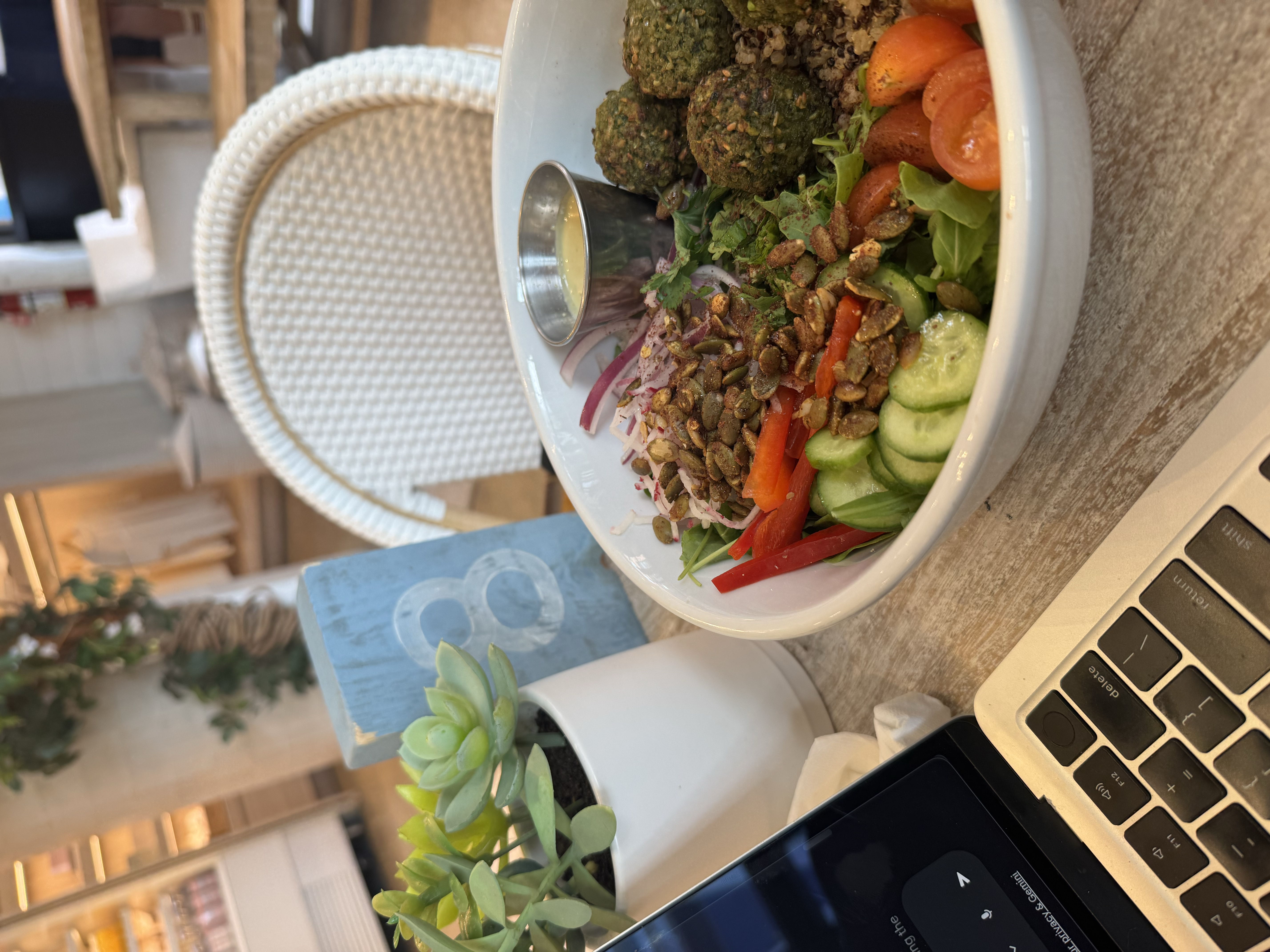
A health bowl restaurant in Williamsburg. The kind of place where the menu says things like “activated” and “superfood.” I was surrounded by designer dogs in purses. I ate something involving falafel and seventeen types of seeds while routing traces on a 13-inch screen. The dogs were better behaved than my ground plane.
Founders event, Williamsburg. A networking event in an office overlooking the city that definitely doesn’t scream “burn rate.” A mix of the best and worst people you’ll ever meet. Did not open KiCad.
Metro North, northbound. Stared at the rat’s nest on the ride home. All the components fit inside the board outline, which felt like a win. The actual routing was too intimidating for a train. Closed the laptop.
My office, the next day. Locked the door, put on headphones, and ground through the routing until the rat’s nest hit zero. Zero unrouted connections. Zero Design Rules Checker violations. Whether it actually works electrically is a question for when the boards arrive.
The board
The Phoebe Spine is a two-layer board, about 60mm by 25mm. It’s the backbone that slides into the bird’s body.
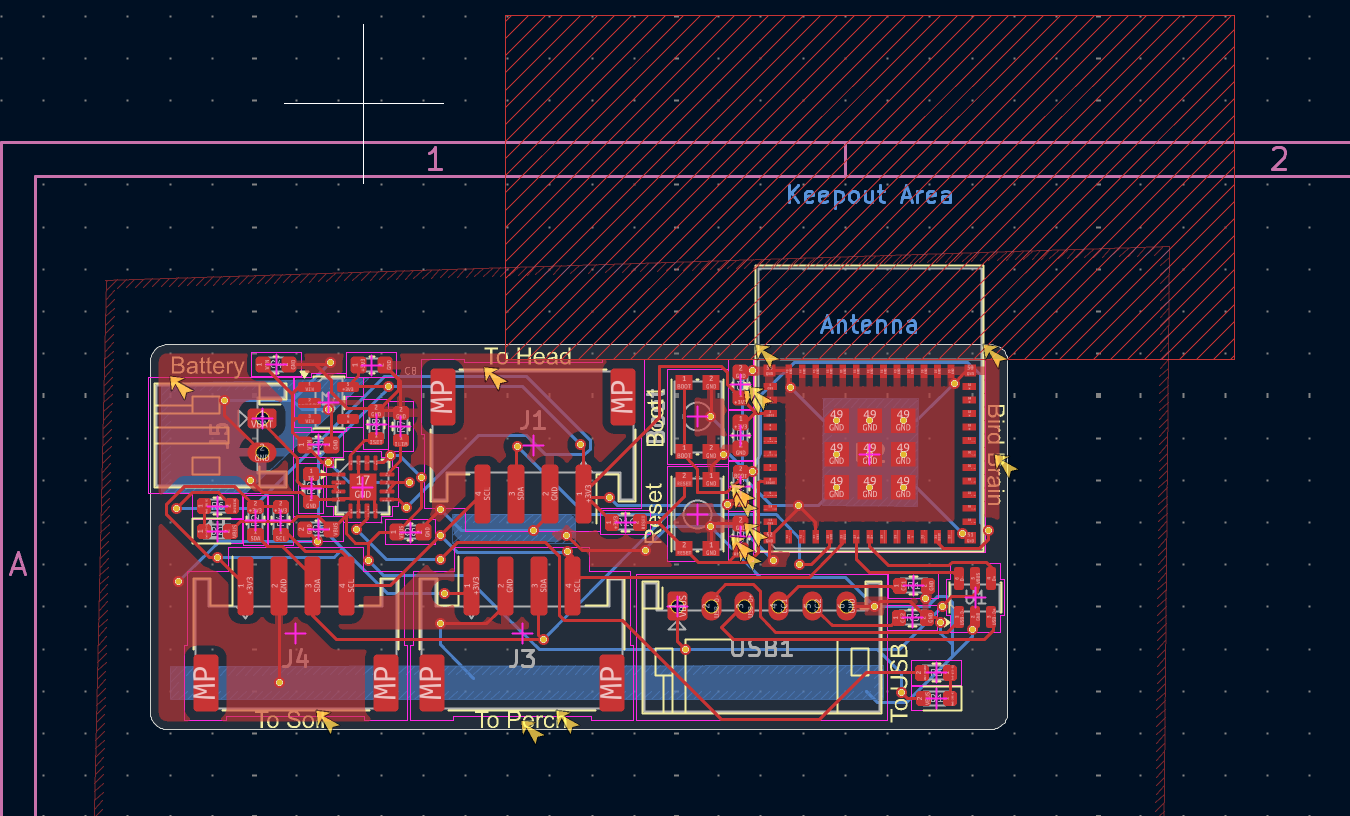
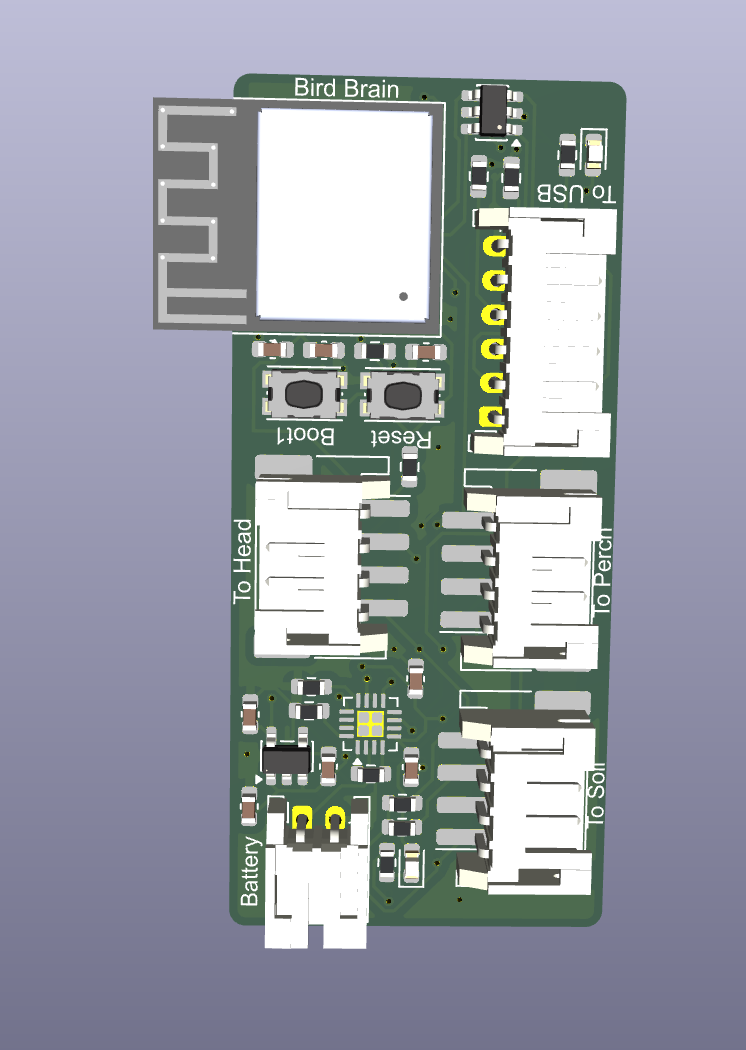
On it: the ESP32-C6 module with its antenna at the top for range, a boost converter to step the 3.7V battery up to a stable 3.3V, the TP4056 charge controller, USB-C for charging and firmware flashing, and pin headers that connect to the head sensors and Perch ports below. Everything the bird needs to think, breathe, and phone home.
Whether any of this will work is genuinely unclear. But the DRC says zero violations, and the 3D render looks like a real board. Next up is the head board for the remaining sensors, and the Perch caps that handle USB-C and the M8 connectors. The prong is already designed. Once the full set is done, I’ll order them all from JLCPCB and find out if coffee shop engineering holds up in the real world.
— Ben